Vedic Astrology vs Western Astrology: Why Your Sign Might Be Different
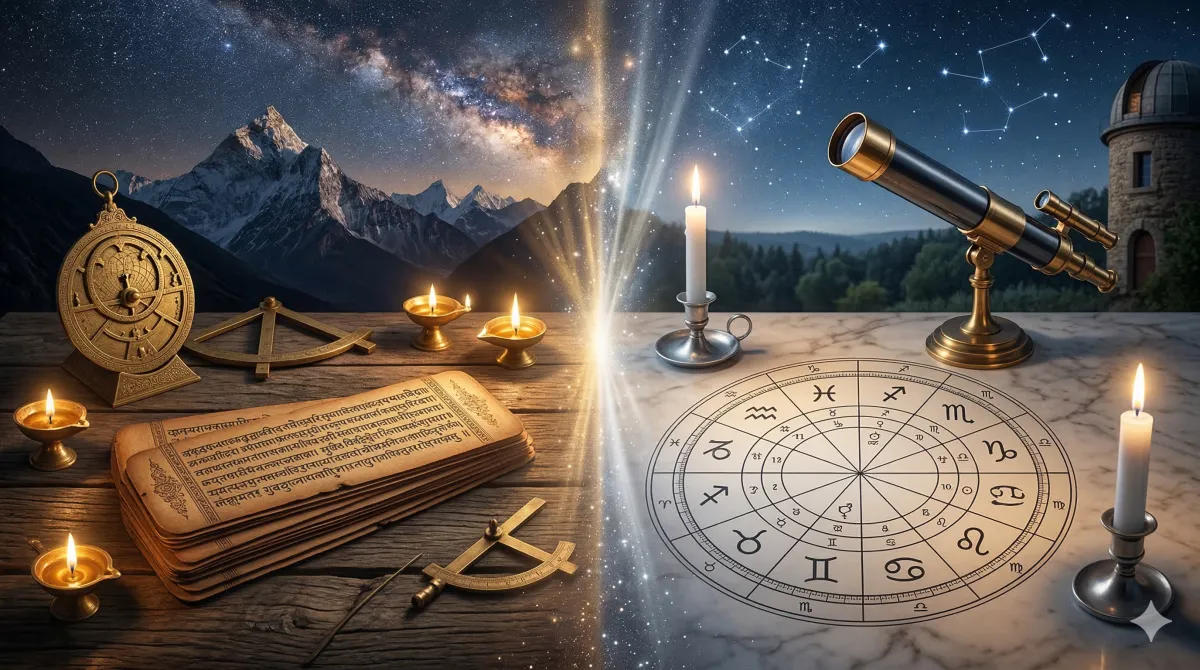
Here's something that catches a lot of people off guard: the zodiac sign you've known your whole life might not be the one Vedic astrology assigns to you. If you've always called yourself a Gemini, a Vedic astrologer might look at your chart and say, "Actually, you're a Taurus." And the wild part? They're not wrong. Neither is your Western horoscope. They're just looking at the sky through different lenses.
This isn't some fringe disagreement between astrologers arguing over coffee. It's a fundamental difference in how two ancient traditions map the heavens — and once you understand why, you'll actually appreciate both systems a whole lot more.
So let's untangle this. No jargon overload, no taking sides. Just a clear, honest look at what makes Vedic and Western astrology different, what each does best, and why your sign might shift when you cross from one system to the other.
The Core Difference: Two Zodiacs, One Sky
Both Vedic and Western astrology divide the sky into 12 zodiac signs of 30 degrees each. Both use the same sign names — Aries, Taurus, Gemini, and so on. So far, so similar. The split happens in where they start counting.
Western astrology uses what's called the tropical zodiac. It anchors the beginning of Aries to the spring equinox — that moment around March 20-21 each year when the Sun crosses the celestial equator heading north. Wherever the Sun is on that day, that's 0 degrees Aries. Period. It's tied to the seasons, not the stars.
Vedic astrology (called Jyotish) uses the sidereal zodiac. It anchors the signs to the actual star constellations behind them. So when Vedic astrology says you're in Aries, it means the Sun (or Moon, or any planet) is literally passing in front of the Aries constellation as seen from Earth.
About 1,700 years ago, these two starting points were in the same place. The spring equinox happened when the Sun was right in front of the Aries constellation. Both systems agreed. But then something slow and steady started pulling them apart.
The Precession of Equinoxes — Explained Simply
Earth doesn't spin perfectly upright. It wobbles. Imagine a spinning top that's starting to slow down — the tip stays in place, but the top traces a slow circle. Earth's axis does the same thing, completing one full wobble roughly every 26,000 years.
This wobble is called the precession of equinoxes, and it causes the spring equinox point to drift backward through the constellations at about 1 degree every 72 years. Doesn't sound like much, right? But over 1,700 years, that adds up to roughly 24 degrees — nearly an entire zodiac sign.
So today, when the spring equinox arrives and Western astrology says "the Sun is at 0 degrees Aries," the Sun is actually sitting in front of the constellation Pisces when you look up at the real sky. Vedic astrology accounts for this drift (using a correction called Ayanamsha). Western astrology doesn't — by design, not by mistake.
This is the reason your Vedic Sun sign is often one sign behind your Western Sun sign. Born a Leo in the Western system? There's a good chance Vedic astrology places your Sun in Cancer. It's not an error. It's a different reference frame.
So Which System Is "Right"?
Honestly? Neither one is wrong. And asking which is "better" is a bit like asking whether a thermometer or a barometer is the better weather instrument. They measure different things.
The tropical zodiac is elegant in its own way. It connects astrology to the seasonal cycle — the rhythm of light and dark, growth and rest that shapes life on Earth. There's a real logic to saying that Aries energy (fiery, initiating, bold) maps to the burst of spring.
The sidereal zodiac connects astrology to the fixed stars — the actual cosmic backdrop that ancient seers observed thousands of years ago. There's a different but equally powerful logic in saying your chart should reflect where the planets truly are among the constellations.
What matters more is what each system does with its zodiac. And this is where things get really interesting.
Where Vedic Astrology Shines
Predictive Power: The Dasha System
If there's one thing that sets Vedic astrology apart, it's the Vimshottari Dasha system. This is a timing tool that Western astrology simply doesn't have an equivalent for.
Here's how it works: based on the position of your Moon in a specific Nakshatra (lunar mansion) at the moment of your birth, Vedic astrology maps out your entire life into planetary periods. Each period is ruled by a planet, and each lasts a set number of years — Saturn's period runs 19 years, Venus gets 20, the Sun gets 6, and so on.
Within each major period, there are sub-periods, sub-sub-periods, and even finer divisions. The result is a remarkably detailed timeline. When a Vedic astrologer says, "You're entering your Jupiter Dasha in two years, and things will shift in career and wisdom," they're not guessing. They're reading a map that's been calculated down to the day.
This is why people often come to Vedic astrology with specific timing questions: When will I get married? When is a good time to start a business? When will this difficult period end? The Dasha system gives concrete answers.
The Nakshatras: 27 Shades of the Moon
Western astrology has 12 signs. Vedic astrology has those same 12 signs (called Rashis) plus 27 Nakshatras — lunar mansions that divide the zodiac into much finer slices of 13 degrees and 20 minutes each.
Your Moon sign tells you a lot in Vedic astrology. But your birth Nakshatra tells you even more. Each Nakshatra has its own deity, symbol, ruling planet, and personality signature. Two people with the Moon in Cancer might have very different temperaments if one's Moon falls in Pushya Nakshatra (nurturing, generous, traditional) and the other's in Ashlesha (intense, perceptive, strategically minded).
It's an extra layer of precision that makes Vedic readings feel remarkably specific. If you want to explore all 27, we've written a complete guide to the Nakshatras.
Divisional Charts and Remedial Measures
Vedic astrology doesn't stop at one chart. From your birth data, a Vedic astrologer can generate 16 or more divisional charts (called Varga charts), each zooming into a specific area of life — career, marriage, parents, spiritual growth, and more. It's like having a microscope with multiple magnification levels.
Then there are remedial measures — practical steps like mantras, gemstones, charitable acts, or rituals that Vedic tradition prescribes to soften difficult planetary influences. Whether or not you embrace the spiritual side, the idea that you're not just stuck with your chart — that you can actively work with it — is a comforting and empowering aspect of the Vedic approach.
Where Western Astrology Shines
Psychological Depth
Western astrology, especially as it's evolved over the last century, has developed a strong psychological orientation. Influenced by thinkers like Carl Jung, modern Western astrologers often use the chart as a mirror for understanding your inner world — your motivations, fears, relationship patterns, and paths toward personal growth.
The language of Western astrology tends to be more about self-awareness than prediction. Instead of "Saturn will bring hardship in your 7th house," a Western astrologer might say, "Saturn's transit through your relationship sector is inviting you to confront patterns of avoidance in intimacy." Same planetary event, different framing.
Outer Planets and Asteroids
Western astrology embraces Uranus, Neptune, and Pluto — the outer planets discovered in the modern era — as major chart factors representing generational shifts, spiritual longing, and deep transformation. Many Western astrologers also incorporate asteroids like Chiron (the "wounded healer") and celestial points like the Vertex.
Traditional Vedic astrology works with the nine classical Grahas: Sun, Moon, Mars, Mercury, Jupiter, Venus, Saturn, plus the two lunar nodes Rahu and Ketu. Some modern Vedic astrologers are beginning to consider the outer planets, but it's not standard practice. The classical system is remarkably potent with just these nine.
Accessibility
Let's be real — Western astrology is more approachable for beginners. Sun sign horoscopes in magazines and apps have made the basics familiar to almost everyone. Vedic astrology has a steeper learning curve, with its Sanskrit terminology, multiple chart systems, and intricate Dasha calculations. But that depth is also its strength once you start exploring it.
Why AstroByVeda Uses Vedic Astrology
We respect both traditions deeply. But at AstroByVeda, we chose to root our practice in Vedic astrology for a few reasons that feel important to us.
First, our astrologers come from authentic Himalayan lineages in Nepal, where Jyotish has been practiced and passed down for generations. This isn't something they picked up from a weekend workshop. It's a living tradition woven into the fabric of daily life, family decisions, and spiritual practice.
Second, we find that people who come to us want specific, actionable guidance. They want to know when to act, what to watch for, and how to navigate what's coming. The Dasha system, Nakshatras, and transit analysis in Vedic astrology are built for exactly that kind of precision.
Third, Vedic astrology's emphasis on the Moon resonates with how we experience life. Your Sun sign describes your outer identity, but your Moon sign — the seat of your mind and emotions — often feels more like the "real you" when you're being honest with yourself. If you haven't explored your Vedic Moon sign yet, our guide to Moon signs is a great place to start.
And finally, the concept of remedies matters to us. We don't believe anyone should feel trapped by their chart. Vedic astrology offers a path for working with challenging placements, not just understanding them.
How to Read Your Chart in Both Systems
If you're curious about your Vedic placements, here's a simple exercise. Take your Western Sun sign and count back roughly one sign. If you're a Virgo born in the first half of September, your Vedic Sun is likely in Leo. If you're a Pisces born in late March, your Vedic Sun is probably in Aquarius.
But here's the thing — your Sun sign alone barely scratches the surface in either system. To really understand your Vedic chart, you'll want to look at your Ascendant (Lagna), your Moon sign, and your Nakshatra. If you're new to reading a Vedic chart, we put together a beginner's guide to reading your Vedic birth chart that walks through the whole thing step by step.
Or, if you'd rather have an experienced astrologer walk you through it personally, that's exactly what we're here for.
The Bottom Line
Vedic and Western astrology aren't competitors. They're two windows looking at the same sky from different angles. Western astrology asks, "Who are you?" Vedic astrology adds, "Who are you, when will things change, and what can you do about it?"
If you've only ever known your Western sign, discovering your Vedic chart can feel like meeting a part of yourself you always sensed but never had words for. The sidereal zodiac, the Nakshatras, the Dasha periods — they add layers of meaning that can make your astrological journey significantly richer.
And the best part? You don't have to choose. You can carry both perspectives with you. But if you're ready to explore the Vedic side of your chart with an astrologer who has grown up within this tradition, we'd love to help you take that first step.
Curious About Your Stars?
Get your first consultation free with an authentic Vedic astrologer from the Himalayas. Share your birth details and receive personalized insights.
Try Your Free ReadingWritten By
Astro By Veda