
How to Read Your Vedic Birth Chart: A Beginner's Guide
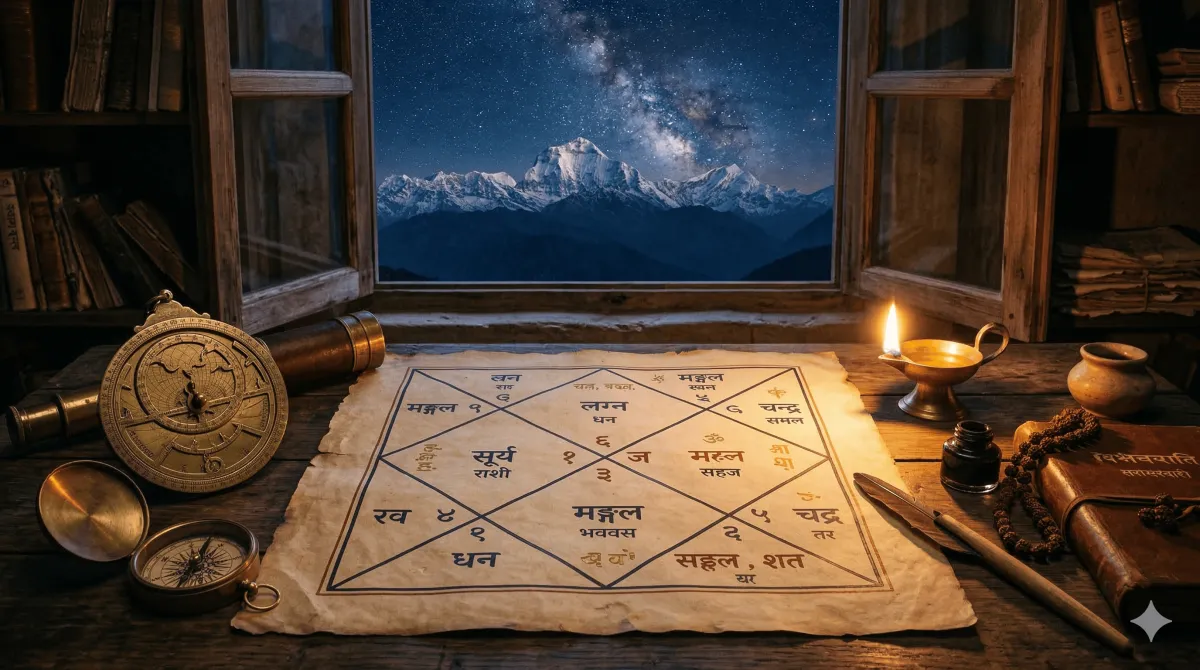
The first time someone handed me a Vedic birth chart, I remember staring at it like it was an ancient treasure map written in a language I didn't speak. Boxes within boxes, strange symbols, abbreviated planet names scattered around like puzzle pieces. If that sounds familiar, you're in exactly the right place.
Here's the thing: your Vedic birth chart — called a Kundali — is genuinely one of the most profound tools for self-understanding that exists. It's been refined over thousands of years by sages in the Himalayan tradition, and it captures something remarkable: a snapshot of the entire sky at the precise moment you took your first breath. That cosmic fingerprint holds insights about your personality, your strengths, the challenges you'll face, and even the timing of major life events.
Let's walk through it together, step by step. No jargon without explanation. No assumptions about what you already know.
What Exactly Is a Vedic Birth Chart?
Think of your Kundali as a map. Not of roads and cities, but of the heavens. When you were born, each planet occupied a specific position in the sky, sitting in a particular zodiac sign and falling into a particular area of life (called a "house"). Your birth chart freezes that moment and lays it out in a diagram you can study.
In Vedic astrology — also called Jyotish, which beautifully translates to "the science of light" — we use the sidereal zodiac. This is different from Western astrology's tropical zodiac. The sidereal system tracks where the constellations actually are in the sky right now, accounting for a slow astronomical wobble called precession. This is why your Vedic Sun sign might be different from your Western one, and that's perfectly normal.
To generate an accurate birth chart, you need three things: your date of birth, your exact time of birth (as precise as possible), and your place of birth. The birth time is especially critical because it determines your Ascendant, which changes roughly every two hours.
The 12 Houses: The Stages of Your Life
Imagine your birth chart as a stage divided into 12 sections. Each section — each house — governs a different area of your life. When a planet sits in a house, it brings its energy and influence to that life domain. Here's what each house represents:
- 1st House (Lagna/Ascendant): Your self, physical body, personality, and how the world sees you. This is the most important house in your entire chart.
- 2nd House: Wealth, family, speech, and the food you eat. It reflects your values — both material and personal.
- 3rd House: Courage, siblings, short travels, communication, and your hobbies. It's your initiative and drive.
- 4th House: Home, mother, emotional peace, property, and vehicles. Your inner sense of comfort lives here.
- 5th House: Creativity, children, romance, education, and past-life merit (Purva Punya). One of the most auspicious houses.
- 6th House: Health challenges, enemies, debts, and daily work. Tough, but also where you build resilience.
- 7th House: Marriage, partnerships, business relationships, and your spouse's nature. Directly opposite the 1st house — it's your mirror.
- 8th House: Transformation, longevity, hidden things, inheritance, and the occult. Deep and mysterious.
- 9th House: Luck, father, higher learning, spirituality, and long-distance travel. Known as the house of fortune.
- 10th House: Career, reputation, public life, and authority. What you're known for in the world.
- 11th House: Gains, income, friendships, elder siblings, and fulfilled desires. Where your wishes come true.
- 12th House: Expenses, foreign lands, spiritual liberation, sleep, and losses. It's the house of letting go.
The 9 Planets (Navagraha): The Actors on Your Stage
If houses are the stages, planets are the actors performing on them. Vedic astrology recognizes nine celestial bodies, called the Navagraha. Each one carries distinct energy:
- Sun (Surya): Your soul, authority, father, government, and vitality. It's your core identity.
- Moon (Chandra): Your mind, emotions, mother, and intuition. In Vedic astrology, the Moon is arguably more important than the Sun. Your Moon sign defines your emotional world.
- Mars (Mangal): Energy, courage, siblings, property, and aggression. The warrior planet.
- Mercury (Budh): Intelligence, communication, commerce, and wit. The planet of learning.
- Jupiter (Guru/Brihaspati): Wisdom, expansion, teachers, children, and blessings. The great benefic.
- Venus (Shukra): Love, beauty, marriage, arts, and luxury. The planet of pleasure and harmony.
- Saturn (Shani): Discipline, karma, delays, hard work, and longevity. Feared by many, but truly the greatest teacher.
- Rahu (North Node): Obsession, foreign things, unconventional paths, and worldly desire. A shadow planet that amplifies whatever it touches.
- Ketu (South Node): Detachment, spirituality, past-life karma, and liberation. Rahu's opposite — it strips away the material.
Rahu and Ketu aren't physical planets. They're the mathematical points where the Moon's orbit crosses the Sun's path, and their influence is powerful and karmic.
The 12 Rashis (Zodiac Signs): The Costumes
Each planet wears the "costume" of whatever zodiac sign it's sitting in. The 12 Rashis in Vedic astrology are the same ones you know — Aries (Mesha), Taurus (Vrishabha), Gemini (Mithuna), Cancer (Karka), Leo (Simha), Virgo (Kanya), Libra (Tula), Scorpio (Vrishchika), Sagittarius (Dhanu), Capricorn (Makara), Aquarius (Kumbha), and Pisces (Meena) — but remember, their positions are sidereal, so they may differ from what you're used to.
Each sign has a ruling planet. Mars rules Aries and Scorpio. Venus rules Taurus and Libra. And so on. When a planet sits in the sign it rules, it feels "at home" and performs well. When it sits in an unfriendly sign, it struggles. This concept of planetary dignity is fundamental to reading any chart.
Your Ascendant (Lagna): The Starting Point
If you take away one thing from this guide, let it be this: your Ascendant is the single most important point in your Vedic birth chart.
The Ascendant — or Lagna — is the zodiac sign that was rising on the eastern horizon the moment you were born. It sets the entire framework of your chart. The sign on your Ascendant becomes your 1st house, and every other house follows in order from there.
In a North Indian style chart (the diamond-shaped one), the Ascendant is always in the top diamond-shaped box. In a South Indian style chart (the square grid), it's marked with a diagonal line or "Asc." The houses rotate around it differently in each style, but the information is the same.
Your Ascendant determines which planets are benefic (helpful) and which are malefic (challenging) specifically for you. This is a concept called functional nature, and it's why the same planet can be wonderful in one person's chart and troublesome in another's.
Reading Planetary Placements
Now comes the part where it all starts connecting. When you look at your chart, notice which planet sits in which house and sign. Ask yourself:
- What does this planet signify? (Use the Navagraha list above.)
- What area of life does this house govern? (Use the house list above.)
- What flavor does the sign add? (Is it a fire sign? Water? Earth? Air?)
- Is the planet comfortable here? (Is it in its own sign, exalted, or debilitated?)
For example, if you find Jupiter in the 5th house in its own sign Sagittarius, that's a beautiful placement. Jupiter (wisdom, expansion) in the 5th house (creativity, children, education) in a sign where it's strong suggests natural talent in teaching, good fortune with children, and a deeply creative mind.
Conversely, Saturn in the 1st house might mean a person who appears serious and reserved, someone who takes on heavy responsibilities early in life but develops tremendous strength and discipline over time.
Aspects and Conjunctions: How Planets Talk to Each Other
Planets don't work in isolation. They interact constantly, and two of the most important interactions are aspects and conjunctions.
A conjunction happens when two or more planets sit in the same house. They blend their energies, for better or worse. Venus and Jupiter together? Often wonderful for relationships and prosperity. Mars and Saturn together? A more intense combination that can create friction but also incredible determination.
Aspects are a bit different. In Vedic astrology, every planet aspects (or "looks at") the house directly opposite it — the 7th house from where it sits. But three planets have special additional aspects:
- Mars also aspects the 4th and 8th houses from itself.
- Jupiter also aspects the 5th and 9th houses from itself.
- Saturn also aspects the 3rd and 10th houses from itself.
When a planet aspects a house, it influences the matters of that house. Jupiter aspecting your 7th house of marriage from the 1st house? That's generally protective and supportive of your partnerships.
The Dasha System: Timing Is Everything
Here's where Vedic astrology truly sets itself apart. The Dasha system — specifically the Vimshottari Dasha — is a predictive timing tool that tells you which planet's energy is most active in your life at any given time.
The system covers a 120-year cycle divided among the 9 planets. Based on the Nakshatra (lunar mansion) your Moon occupies at birth, you start life in a particular planet's Dasha period. Each major period (Mahadasha) lasts a specific number of years — Sun gets 6 years, Moon gets 10, Mars gets 7, Jupiter gets 16, Saturn gets 19, and so on.
Within each Mahadasha, there are sub-periods (Antardashas) ruled by other planets, creating layers of timing that an experienced astrologer can interpret with remarkable precision.
"The birth chart tells you what your life contains. The Dasha system tells you when those contents will unfold."
This is why two people with similar chart placements can have very different experiences at the same age — they're running different Dasha periods, activating different parts of their chart.
Putting It All Together
Reading a Vedic birth chart is like learning a language. The alphabet is the planets, signs, and houses. The grammar is aspects, conjunctions, and planetary dignity. And the stories — the rich, complex, deeply personal stories — emerge when you start reading sentences, paragraphs, and chapters together.
Start with your Ascendant. Then look at where the Ascendant lord (the planet ruling your Ascendant sign) is placed. Check your Moon sign and Moon's Nakshatra. Notice which houses have planets and which are empty. Look at Jupiter and Saturn, the two most impactful slow-moving planets.
Be patient with yourself. Experienced Vedic astrologers from the Himalayan tradition spend decades refining their ability to weave all these threads into coherent insight. What matters at the beginning is curiosity — and you clearly have that, since you're here reading this.
Your Next Step
Understanding the basics is a wonderful first step. But a birth chart is a living, breathing document with layers that reveal themselves only through experienced eyes. If you're curious about what your specific planetary placements, Dasha periods, and house configurations mean for your life right now, our Himalayan astrologers would love to walk you through it.
Your first consultation is completely free — no strings attached. Share your birth details, and one of our authentic Vedic astrologers from Nepal will prepare a personalized reading just for you. It's the best way to see your chart come alive.
Want to go deeper into specific topics? Learn about the importance of your Moon sign in Vedic astrology, or explore the fascinating world of the 27 Nakshatras (lunar mansions) that add incredible depth to your chart. And to understand how our consultation process works, we've laid it all out simply.
Curious About Your Stars?
Get your first consultation free with an authentic Vedic astrologer from the Himalayas. Share your birth details and receive personalized insights.
Try Your Free ReadingWritten By
Astro By Veda