Rahu and Ketu in Your Birth Chart: The Karmic Nodes Explained
Of all the planets in Vedic astrology, none are quite as mysterious — or as misunderstood — as Rahu and Ketu. They have no physical body. You can't point a telescope at the sky and find them. They're called shadow planets, and yet they might be the most powerful forces in your entire birth chart.
If you've ever looked at your Vedic birth chart and wondered what those two enigmatic points represent, you're about to find out. And I'll tell you upfront: understanding Rahu and Ketu can be one of the most profound "aha" moments in your astrological journey. They speak directly to your soul's purpose — where you've been, and where you're headed.
The Mythology: A Demon, an Ocean, and Immortal Nectar
The story of Rahu and Ketu is one of the great tales of Hindu mythology, and it's worth knowing because the symbolism runs deep.
Long ago, the gods (Devas) and demons (Asuras) joined forces to churn the cosmic ocean — the Samudra Manthan — in search of Amrita, the nectar of immortality. After ages of churning, the nectar finally appeared, and the gods began distributing it among themselves, keeping it from the demons.
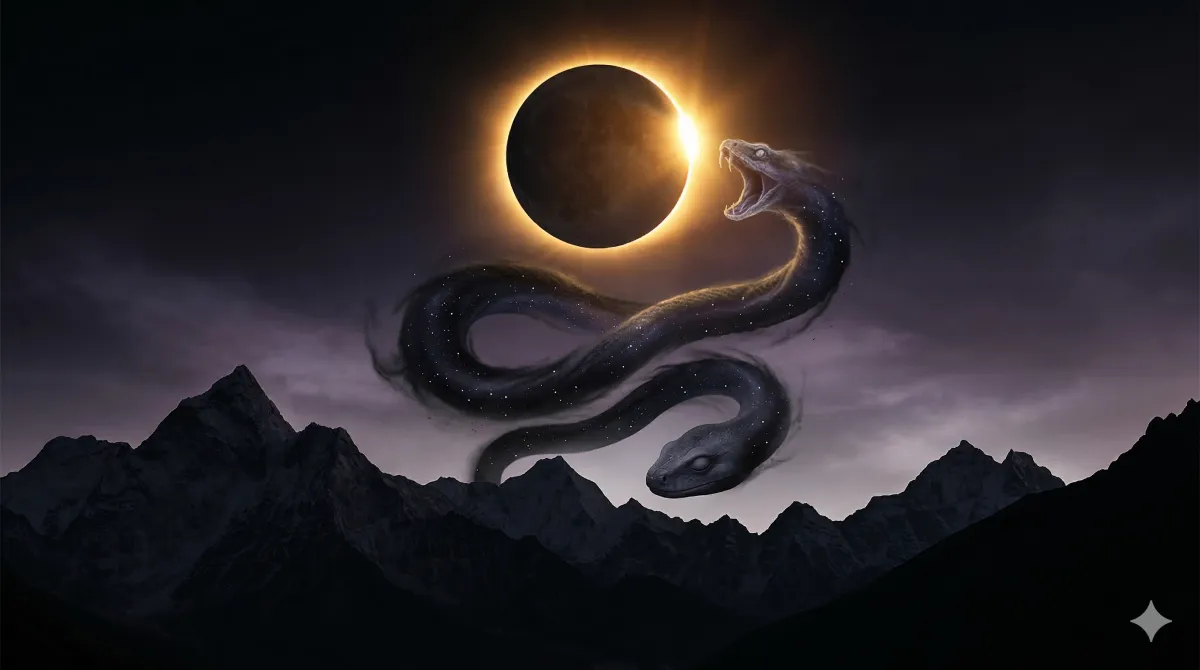
But one cunning demon named Svarbhanu disguised himself as a god and slipped into the line. He sat between the Sun and the Moon and managed to take a sip of the nectar. Before he could swallow it fully, the Sun and Moon recognized his disguise and alerted Lord Vishnu, who immediately hurled his divine discus — the Sudarshana Chakra — and severed the demon's head from his body.
But here's the twist: the nectar had already touched his throat. Both halves became immortal. The head became Rahu. The body became Ketu. And to this day, they are said to chase the Sun and Moon across the sky, periodically swallowing them — which is how the ancient sages explained eclipses.
It's a beautiful, vivid story. But it's also a profound metaphor. Rahu is the head without a body — endless hunger, insatiable desire, always consuming but never satisfied. Ketu is the body without a head — action without direction, intuition without logic, spiritual knowing that bypasses the intellect entirely.
What Rahu and Ketu Actually Are
In astronomical terms, Rahu and Ketu are the North and South lunar nodes — the two points where the Moon's orbital path crosses the ecliptic (the Sun's apparent path). These aren't planets at all. They're mathematical points in space. But in the Vedic tradition, they carry enormous weight.
Rahu and Ketu always sit exactly opposite each other in the chart. When Rahu is in Aries, Ketu is in Libra. When Rahu is in the 1st house, Ketu is in the 7th. They move in retrograde motion — backward through the zodiac — spending roughly 18 months in each sign and completing a full cycle in about 18 years.
Together, they form an axis — a karmic axis that connects your past to your future, your comfort zone to your growth edge.
Rahu: The Head of the Serpent
Rahu is hunger. Rahu is ambition. Rahu is the part of you that wants — desperately, sometimes obsessively — and reaches toward things you haven't yet mastered.
In your chart, Rahu's house and sign placement show where your soul is being pulled in this lifetime. It's unfamiliar territory. It's exciting and disorienting. Rahu's domain is the area where you'll feel an almost magnetic attraction, even if you don't fully understand why.
Rahu is associated with:
- Worldly ambition and material desire — the drive for status, wealth, and recognition
- Innovation and unconventionality — breaking norms, foreign cultures, technology
- Obsession and illusion — things that seem more appealing than they actually are
- Sudden events — unexpected gains, dramatic changes in direction
- Foreign connections — travel, immigration, dealing with cultures different from your own
When Rahu is well-placed, it can bring extraordinary worldly success, fame, and the ability to thrive in unconventional paths. When it's challenged, it can create confusion, addiction, and a relentless hunger that nothing seems to fill.
Ketu: The Tail of the Serpent
Ketu is the opposite current. Where Rahu craves, Ketu releases. Where Rahu looks outward, Ketu turns inward.
Ketu's placement in your chart shows what your soul has already mastered — talents and tendencies carried over from past lives. There's a natural ease here, an almost effortless competence. But there's also a sense of "been there, done that." Ketu can make you feel detached from the very things you're naturally good at, because your soul is ready to move beyond them.
Ketu is associated with:
- Spirituality and liberation — the pull toward moksha, transcendence, inner freedom
- Past life mastery — innate skills and deep knowing that can't be easily explained
- Detachment and surrender — letting go of what no longer serves you
- Mysticism and healing — psychic sensitivity, intuition, alternative medicine
- Confusion and loss — at its most challenging, a feeling of being lost or disconnected
A well-placed Ketu bestows deep spiritual wisdom, sharp intuition, and the rare ability to be genuinely unattached to outcomes. A challenged Ketu can manifest as aimlessness, self-doubt, or difficulty engaging with practical life.
Rahu and Ketu Through the 12 Houses
The house placement of Rahu and Ketu is where things get personal. Here's a brief guide to what each axis means in your birth chart:
Rahu in the 1st / Ketu in the 7th: Your soul is learning to develop a strong individual identity. Past lives emphasized partnerships and compromise. This lifetime pushes you toward self-discovery, even if it creates tension in relationships.
Rahu in the 2nd / Ketu in the 8th: The drive is toward building personal wealth, family stability, and self-worth. Ketu in the 8th suggests past familiarity with crisis, transformation, and other people's resources. Now it's time to stand on your own.
Rahu in the 3rd / Ketu in the 9th: Courage, communication, and entrepreneurial effort are calling. Ketu in the 9th indicates past lives immersed in philosophy, religion, or higher learning. Now the soul grows through practical action.
Rahu in the 4th / Ketu in the 10th: Emotional security, home, and inner peace are the soul's frontier. Ketu in the 10th suggests past mastery of career and public life. This time around, the heart needs attention more than the resume.
Rahu in the 5th / Ketu in the 11th: Creative self-expression, romance, and children become arenas of growth. Ketu in the 11th shows a soul well-versed in networks and collective goals, now learning to shine individually.
Rahu in the 6th / Ketu in the 12th: Service, health, and overcoming daily challenges become the path forward. Ketu in the 12th indicates deep past-life spiritual development. Now the soul must engage with the practical, messy world.
Rahu in the 7th / Ketu in the 1st: Partnerships, marriage, and learning to truly see others are the soul's lessons. Ketu in the 1st suggests a strong sense of self from previous lives. Growth comes through genuine collaboration.
Rahu in the 8th / Ketu in the 2nd: Transformation, occult knowledge, and deep psychological exploration call to you. Ketu in the 2nd shows past-life security with wealth and family. Now the soul dives into deeper waters.
Rahu in the 9th / Ketu in the 3rd: Higher learning, spiritual seeking, and long journeys become the growth edge. Ketu in the 3rd indicates past mastery of communication and courage. Now the soul reaches for wisdom.
Rahu in the 10th / Ketu in the 4th: Career, public recognition, and worldly achievement are the arena. Ketu in the 4th suggests a soul comfortable with domestic and emotional life. This lifetime pushes you onto a larger stage.
Rahu in the 11th / Ketu in the 5th: Large networks, social causes, and fulfilling ambitions are the direction. Ketu in the 5th shows past creative and romantic mastery. Now the soul learns to think bigger than personal expression.
Rahu in the 12th / Ketu in the 6th: Spiritual surrender, foreign lands, and transcendence pull you forward. Ketu in the 6th indicates past-life mastery of service and problem-solving. Now the soul seeks something beyond the material.
Rahu and Ketu Dasha Periods
In the Vimshottari Dasha system — the primary timing tool of Vedic astrology — Rahu Dasha lasts 18 years and Ketu Dasha lasts 7 years. These are among the most transformative periods you can experience.
During Rahu Dasha, life often accelerates. You might feel driven toward new goals with an almost feverish intensity. Career changes, relocations, encounters with foreign cultures, sudden rises (and sometimes falls) — Rahu doesn't do anything quietly. The key during this period is to pursue your ambitions with awareness. Rahu can give you everything you think you want, only for you to realize the wanting was the point all along. Stay grounded. Question your motives. Don't mistake intensity for truth.
During Ketu Dasha, the energy reverses. The outer world may feel less interesting. Relationships might shift. Things you once valued deeply can suddenly feel hollow. This isn't depression — it's Ketu stripping away what your soul has outgrown. Many people experience profound spiritual openings during Ketu Dasha. Meditation deepens. Intuition sharpens. There's a quiet, powerful invitation to let go.
If you're curious about which Dasha period you're currently in and what it means for you specifically, that's exactly the kind of question a skilled Vedic astrologer can help you unpack in detail.
Eclipses and the Nodes
Here's where the mythology comes full circle. Eclipses happen when the Sun or Moon come close to either Rahu or Ketu — when the luminaries approach the nodes. A solar eclipse occurs near a new moon at the Rahu-Ketu axis. A lunar eclipse occurs near a full moon along the same axis.
In Vedic astrology, eclipses are potent karmic triggers. They're moments when the veil thins, when hidden things surface, when fated events unfold. An eclipse falling on a sensitive point in your birth chart — say, conjunct your Ascendant or Moon — can mark a significant turning point.
"Eclipses reveal what was hidden. They don't create new karma — they accelerate the karma that was already ripening."
This is why traditional Vedic teachings advise caution during eclipses: avoid starting major new ventures, practice meditation and mantra, and allow the energy to settle before making big decisions. It's not superstition — it's respect for a powerful astronomical and spiritual event.
Working with Your Nodes
The beautiful thing about understanding Rahu and Ketu in your chart is that it gives you a roadmap for your soul's evolution. You don't have to fight Rahu's pull or suppress Ketu's detachment. The wisdom is in balance.
Honor Ketu by acknowledging your innate gifts and the wisdom you carry. Don't abandon your strengths — but don't cling to them either. Honor Rahu by having the courage to step into unfamiliar territory, to grow, to reach for something you've never been before. Just do it with your eyes open.
If you'd like to understand exactly where Rahu and Ketu fall in your chart and what that means for your specific life path, our astrologers at AstroByVeda can walk you through it with depth and care. Your first consultation is free — just share your birth details and we'll connect you with an authentic Vedic astrologer from the Himalayan tradition who can illuminate the karmic story written in your stars.
Curious About Your Stars?
Get your first consultation free with an authentic Vedic astrologer from the Himalayas. Share your birth details and receive personalized insights.
Try Your Free ReadingWritten By
Astro By Veda