
Kundali Matching for Marriage: What the Stars Really Reveal About Compatibility
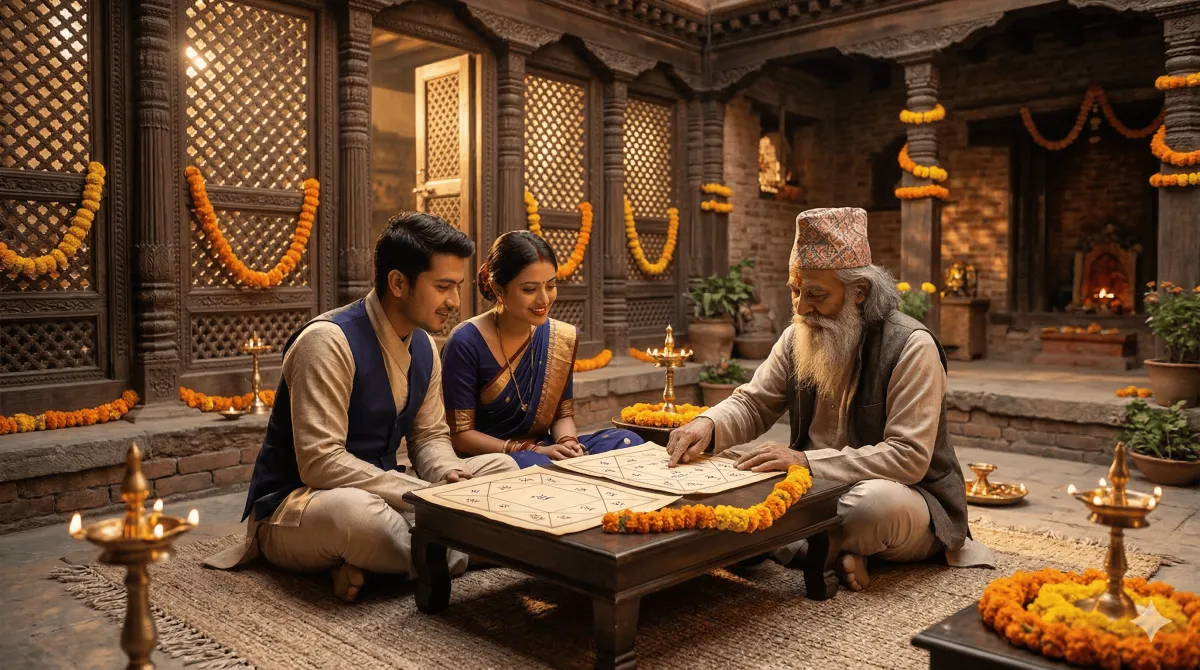
There's a conversation that happens in millions of families across South Asia, and increasingly in diaspora communities around the world. Someone falls in love, or a family finds a promising match, and the question arises: "Have the Kundalis been matched?"
If you've landed on this page, you're probably in one of two camps. Either you're genuinely curious about what Kundali matching involves and whether it has real value, or someone in your family insists on it and you want to understand what's actually happening behind those numbers. Both are perfectly good reasons to be here. Let's talk about it honestly.
What Is Kundali Matching, Really?
Kundali matching — also called Guna Milan, horoscope matching, or Kundali Milan — is the practice of comparing the birth charts of two people to assess their compatibility for marriage. It's been a core part of the Vedic tradition for centuries, developed by sages who believed that celestial harmony between partners translates into earthly harmony in the home.
The process primarily looks at the Moon signs and Nakshatras (lunar mansions) of both individuals. Why the Moon? Because in Vedic astrology, the Moon governs your mind, emotions, and inner world — exactly the parts of yourself that show up most intensely in a marriage. You might present your Sun-sign self to the world, but your partner lives with your Moon.
The most widely used system evaluates compatibility across 8 categories called Kootas, with a total of 36 points (Gunas) available. This is the Ashtakoota system, and it's what most people mean when they talk about "Guna matching."
The Ashtakoota System: All 8 Kootas Explained
Let's walk through each of the 8 Kootas. Understanding what each one measures helps you see that this isn't just a random number generator — each category addresses a real dimension of compatibility.
1. Varna (1 Point) — Spiritual Compatibility
Varna assesses the general temperament and spiritual outlook of each person. The four Varnas — Brahmin (priestly), Kshatriya (warrior), Vaishya (merchant), and Shudra (service) — correspond to the elements and basic disposition. It's about whether two people approach life with a compatible worldview. Worth only 1 point, it carries the least weight.
2. Vashya (2 Points) — Mutual Influence
This Koota examines the power dynamic between partners. Can each person positively influence the other? Is there mutual respect, or will one person dominate? The ideal is balanced influence where both partners feel heard and valued.
3. Tara (3 Points) — Birth Star Compatibility
Tara looks at the Nakshatra (birth star) compatibility between the two people. It evaluates the health and well-being of the relationship — whether being together supports or drains each person's vitality. A good Tara score suggests the couple will genuinely thrive in each other's company.
4. Yoni (4 Points) — Intimacy and Physical Compatibility
This one makes people a little uncomfortable, but it matters. Yoni assesses the physical and intimate compatibility between partners. Each Nakshatra is associated with an animal symbol, and the relationship between those animals indicates the nature of physical harmony. A good Yoni match suggests natural comfort and satisfaction in the intimate dimension of marriage.
5. Graha Maitri (5 Points) — Mental Compatibility
Now we're getting into the heavier categories. Graha Maitri examines the friendship between the ruling planets of both Moon signs. If the Moon sign lords are natural friends (like Jupiter and Mars), mental compatibility is strong. If they're enemies (like Sun and Saturn), there may be fundamental differences in how the two people think and process the world. This is about whether your minds naturally "get" each other.
6. Gana (6 Points) — Temperament Match
Gana divides temperaments into three categories: Deva (divine/gentle), Manushya (human/balanced), and Rakshasa (intense/assertive). Despite the names, none of these is inherently good or bad. A Deva person is gentle and accommodating. A Rakshasa person is fiercely independent and strong-willed. Two Rakshasa types can have a passionate, powerful marriage. But a Deva-Rakshasa pairing may struggle with fundamentally different approaches to conflict and daily life. At 6 points, Gana is one of the most influential Kootas.
7. Bhakoot (7 Points) — Emotional and Financial Harmony
The highest-scoring individual Koota. Bhakoot examines the relationship between both partners' Moon signs by house position. Certain combinations — like 6-8 or 2-12 relationships between Moon signs — are considered challenging because they can create emotional misunderstandings or financial stress. Other combinations are naturally supportive. A full 7 points here is a strong positive signal for the marriage's emotional and material stability.
8. Nadi (8 Points) — Health and Genetic Compatibility
The single most important Koota, carrying 8 of the 36 points. Nadi relates to the fundamental constitution — Vata (air), Pitta (fire), or Kapha (earth/water). When both partners have the same Nadi, it's called Nadi Dosha, and it's considered the most serious compatibility issue in the system. Traditionally, it was linked to health problems in offspring, though modern understanding treats it more broadly as a deep constitutional mismatch. Losing all 8 Nadi points can make an otherwise strong match look weak on paper.
What the Scores Actually Mean
So you've had the matching done and received a number. Here's the general framework astrologers use:
- Below 18 out of 36: Generally considered insufficient for marriage. The fundamental compatibility may have significant gaps. However — and this is important — a low score doesn't automatically mean the relationship is doomed. It means additional chart analysis is needed.
- 18-24 out of 36: An acceptable match. Most marriages fall in this range. There will be areas of natural harmony and areas that require conscious effort and compromise. This is a realistic, workable foundation.
- 24-28 out of 36: A good match. Strong compatibility across most dimensions. The couple is likely to find partnership comes naturally, with fewer fundamental friction points.
- 28+ out of 36: An excellent match. High natural compatibility. But here's the honest truth — an exceptionally high score doesn't guarantee a perfect marriage. Every relationship requires effort, communication, and growth. The stars can give you a head start; they can't do the work for you.
"A good Kundali match is like fertile soil. It gives the seeds of love the best chance to grow. But someone still has to tend the garden."
Mangal Dosha: The Most Misunderstood Factor
No discussion of Kundali matching is complete without addressing Mangal Dosha — and no topic in Vedic astrology generates more unnecessary fear. Read our detailed guide on Mangal Dosha in Kundali for the full picture, but here's what you need to know.
Mangal Dosha occurs when Mars occupies the 1st, 4th, 7th, 8th, or 12th house in a birth chart. It's associated with potential marital discord, and tradition recommends that a Manglik (someone with Mangal Dosha) should ideally marry another Manglik to balance the energies.
But here's what many people don't tell you:
- Roughly 40-50% of people have some form of Mangal Dosha by the broadest definitions. It's not rare or unusual.
- Multiple cancellation conditions exist. If Mars is in its own sign, if Jupiter aspects Mars, if the Dosha is present in certain specific houses with mitigating factors — the Dosha can be significantly weakened or nullified.
- The Dosha's intensity varies enormously. Mars in the 7th house in a fire sign is very different from Mars in the 4th house in a water sign. Blanket statements about Mangal Dosha are almost always oversimplified.
- Age can diminish its effects. Many traditional astrologers hold that Mangal Dosha's impact weakens significantly after age 28.
The bottom line: don't panic about Mangal Dosha. Get it assessed by a qualified Vedic astrologer who will look at the full chart context, not just a checkbox.
What Kundali Matching Can't Tell You
Let's be honest about the limitations, because intellectual honesty makes astrology more useful, not less.
Kundali matching cannot measure the effort two people are willing to put into their relationship. It cannot account for shared experiences, inside jokes, the way someone makes you feel safe, or the willingness to grow together through hard seasons. It doesn't know about communication skills, emotional maturity, or whether someone is kind to waiters.
The Ashtakoota system specifically looks at Moon-sign-level compatibility. It does not replace a full chart analysis, which would examine the 7th house, 7th lord, Venus, Jupiter, Dasha compatibility, and Navamsha chart (the divisional chart specifically for marriage). A truly comprehensive compatibility analysis goes far deeper than 36 Gunas.
This is why a number on a screen is never the full story. If you're curious about when marriage might be on the horizon based on your Dasha periods and transits, that's a separate but equally fascinating analysis.
A Modern Perspective on Traditional Matching
Here's how we think about Kundali matching at Astro By Veda, drawing from the Himalayan tradition our astrologers were raised in:
Kundali matching is a tool for understanding, not a tool for judgment. It's at its best when used to identify potential challenges so a couple can prepare for them consciously. A difficult Gana match? That's not a dealbreaker — it's an invitation to develop better conflict resolution skills. A Nadi Dosha? Worth exploring with a professional, but not a reason to cancel a wedding in panic.
The sages who developed this system were practical people. They lived in a time when marriages were arranged between families who might not know each other well. Kundali matching was a sophisticated screening tool — a way to add cosmic data to a very human decision. It was never meant to be the only factor.
In today's world, where many couples already know each other deeply before considering marriage, Kundali matching serves a different but equally valuable role. It offers a language for discussing dynamics you might already sense intuitively. "Oh, that's why we argue about money" or "No wonder we handle stress so differently" — these insights can strengthen a relationship by making the invisible visible.
Getting Your Kundali Matched the Right Way
If you're considering Kundali matching — whether for an arranged match or a love marriage — here's our sincere advice:
- Use accurate birth times. Even a few minutes' difference can change your Nakshatra and shift your results. Both partners need reliable birth data.
- Go beyond the score. The number is a starting point. A skilled astrologer will analyze why certain Kootas scored the way they did and what it means practically.
- Don't ignore Doshas, but don't fear them. Mangal Dosha, Nadi Dosha — these deserve proper assessment, not headline-level panic.
- Look at the full charts. Request a comprehensive compatibility reading that examines both Kundalis in full, including the Navamsha chart, Dasha alignment, and 7th house analysis.
- Remember that you are more than your chart. Your choices, your growth, your willingness to love well — these matter immensely, and no birth chart can fully capture them.
Ready to Explore Your Compatibility?
Whether you're about to meet your partner's family, planning a wedding, or simply curious about how you and your significant other align in the stars, our Himalayan astrologers bring generations of authentic Vedic knowledge to every reading. They'll go beyond the numbers to give you real, nuanced insight you can actually use.
Your first consultation is completely free. Share your birth details and your partner's, and receive a detailed compatibility reading from an authentic Vedic astrologer from Nepal. No pressure, no fear-mongering — just clear, honest guidance rooted in thousands of years of wisdom.
Want to learn more? Explore how our consultation process works, or read about Mangal Dosha and marriage timing in Vedic astrology to deepen your understanding.
Curious About Your Stars?
Get your first consultation free with an authentic Vedic astrologer from the Himalayas. Share your birth details and receive personalized insights.
Try Your Free ReadingWritten By
Astro By Veda